Category: Agentic AI

  • From Mainframe to Mindset: The Surprising Leap from COBOL to AI Intelligence

    From Mainframe to Mindset: The Surprising Leap from COBOL to AI Intelligence

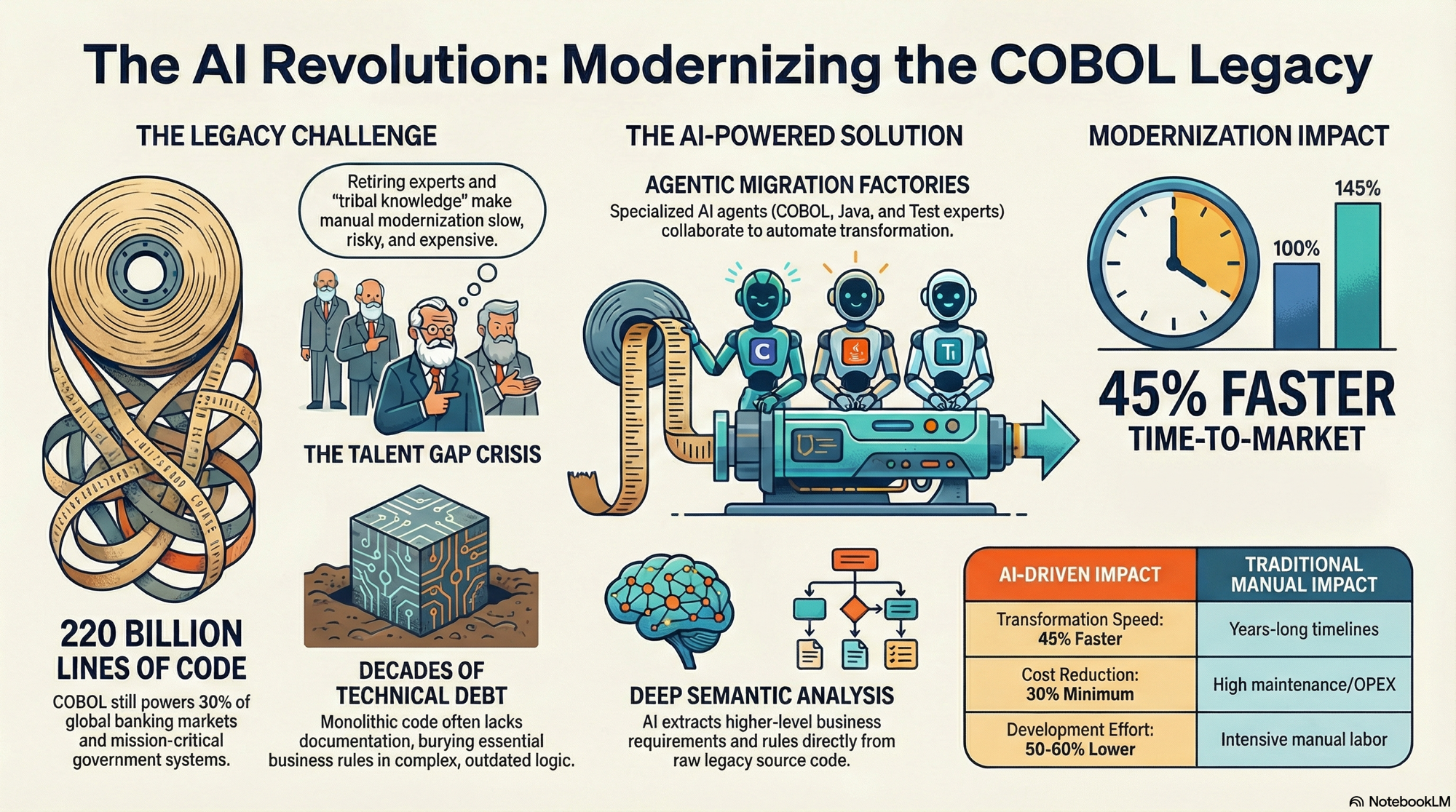
    For decades, the enterprise has been haunted by the ghost of “legacy.” We’ve been told that the core logic of our businesses—the trillions of rows of data locked in 60-year-old COBOL files—is a liability, a frozen asset too fragile to touch and too complex to modernize. But as a digital transformation strategist, I see a different reality. This isn’t technical debt; it is the untapped IQ of your organization.

    The “Legacy Logic” framework is shattering the traditional modernization roadmap. By leveraging Metadata Garage Services, the bridge between the mainframe and the frontier of AI has become remarkably short. We are no longer talking about a multi-year migration nightmare; we are talking about a fundamental shift in mindset that turns a “static garage” of records into a high-velocity AI Intelligence Hub.

    The Zero-Refactor Revolution

    The single greatest barrier to innovation is the “Prep-Work Myth.” Conventional wisdom dictates that before AI can even glance at legacy data, you must endure years of refactoring, manual coding, and grueling data normalization. For most CIOs, touching the legacy core is a high-stakes risk that threatens the very stability of production environments.

    Metadata Garage Services provides the ultimate “read-only” path to intelligence, effectively breaking the shackles of technical debt without jeopardizing the system of record. The mandate is clear: you can now move toward “AI from your COBOL files with no coding, requirements, or preparation.”

    By removing the need for manual intervention or system overhauls, we shift the culture of the IT department from “maintenance and defense” to “innovation and insight.” You don’t need to rewrite your history to benefit from the future; you simply need the right interface to access it.

    The Automated On-Ramp: From Blind Storage to Statistical Clarity

    Every failed digital transformation starts with messy data. In the legacy world, COBOL files are often “black boxes”—raw records that offer zero visibility to modern tools. To an LLM (Large Language Model), an unmapped mainframe file is just noise.

    This is where the “Legacy Logic” tools provide an essential on-ramp. By processing COBOL data files and gathering automated statistics, these tools create a comprehensive “context map” of your historical data. We are moving from blind storage to instant visibility, transforming raw records into a viable, structured starting point for intelligence. This statistical baseline is the “ground truth” that allows an AI to navigate decades of enterprise memory with precision. It turns what was once “dark data” into a clear, searchable asset before a single prompt is even written.

    Conversational IQ: Turning Records into an Intelligence Hub

    The true “Mindset” shift occurs when we stop viewing data as a report and start viewing it as a conversation. Through the integration of processed records into NotebookLM, we are creating a sophisticated AI Intelligence Hub that fundamentally changes how stakeholders interact with the past.

    Imagine the power of moving away from a COBOL programmer writing a batch report that takes three days to execute. Instead, a CEO or Product Manager can ask a natural language question: “Compare our highest-performing insurance riders from 1985 against current market trends—what logic are we missing?”

    By loading legacy records into a conversational notebook environment, the data is no longer a static archive; it is a live participant in strategic decision-making. This workflow turns the “Legacy Garage” into a fountain of insights, allowing the enterprise to “talk” to its history through a 21st-century interface.

    The Future of the Mainframe

    The transition from COBOL to AI is not about replacement; it is about liberation. Metadata Garage Services proves that the mainframe can remain a foundational asset while its data is freed to fuel modern competitive advantages. By automating the extraction and statistical mapping of legacy files, we bridge the gap between the mid-20th-century engine and the AI-driven future.

    The technical hurdles have been cleared. The only remaining question is one of vision: What transformative insights are currently hidden in your own legacy “garage,” just waiting to be uncovered?
  • Why Your Mainframe Data Already Has a Map to the Cloud (And It’s Not in the Code)

    Why Your Mainframe Data Already Has a Map to the Cloud (And It’s Not in the Code)

    • Headline: Why Your Mainframe Data Already Has a Map to the Cloud (And It’s Not in the Code)
    • Intro: Start with the anxiety. Paradox: Millions spent hiding from legacy code, but the metadata (the map) is right there.
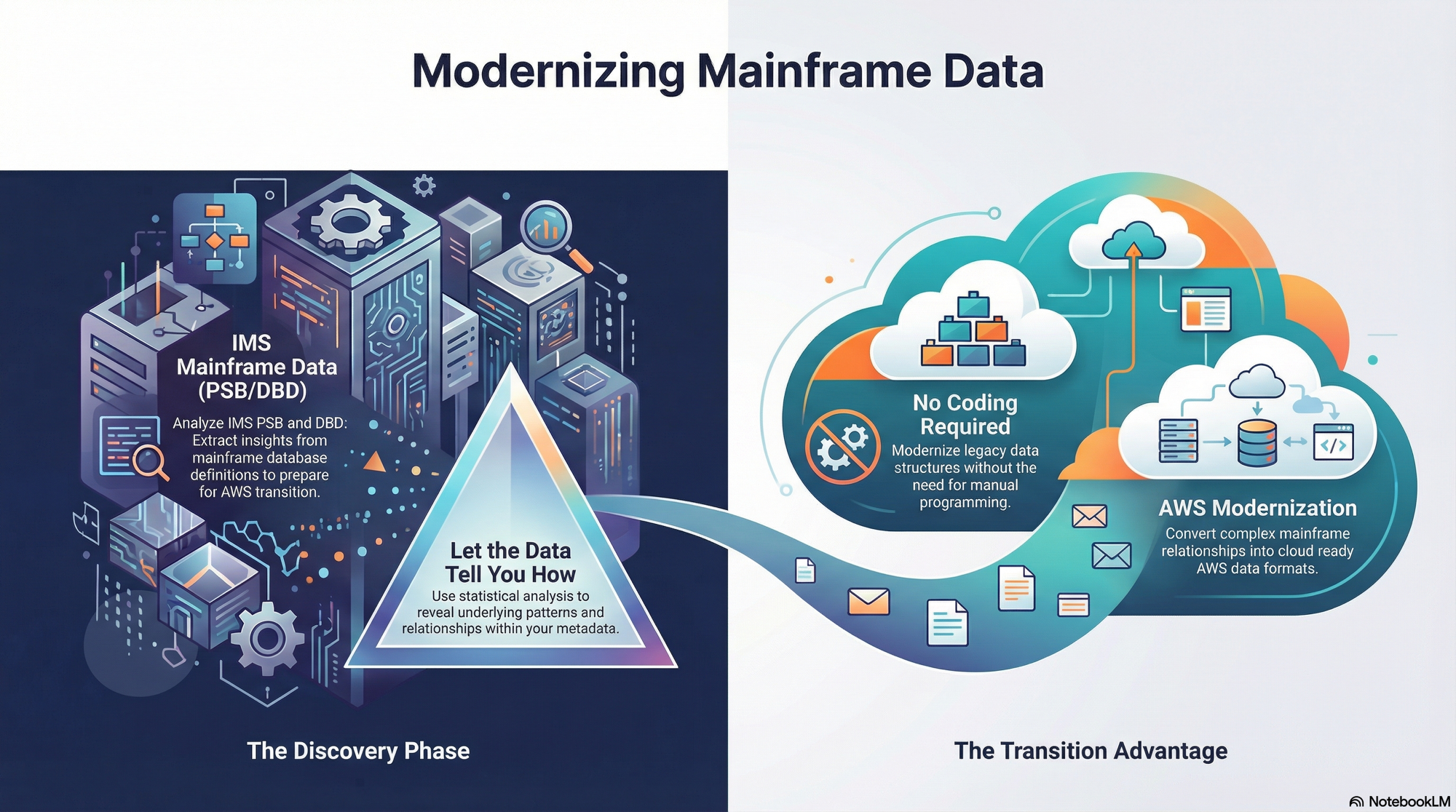
    • Takeaway 1: Letting Your Data Tell the Story. Statistical analysis of patterns/relationships. Usage frequency. Pruning.
    • Takeaway 2: The End of the “Manual Coding” Bottleneck. No code. Talent gap in COBOL/IMS. Shortening value-realization.
    • Takeaway 3: Navigating the IMS to AWS Transition. Deep dive into PSB/DBD. Relational integrity.
    • Conclusion: Future of modernization. Fighting data vs leading with it.

    Check against “Source Context”: “prepare for transition to AWS from IMS PSB DBD with statistic analysis and let your data tell you how with patterns and relationsips reveal in you data we e at metadata mechanic can helps no cocding required”

    All elements included.

    One final check on the persona: “Modernization Architect & Strategic Technology Consultant.” Tone should be authoritative.

    (Proceeding to generate final output).# Why Your Mainframe Data Already Has a Map to the Cloud (And It’s Not in the Code)

    The Legacy Modernization Paradox

    For most enterprise organizations, the prospect of migrating legacy mainframe environments to the cloud is a source of profound strategic anxiety. The transition from IMS PSB (Program Specification Block) and DBD (Database Description) architectures to AWS is often viewed as a high-stakes scavenger hunt through decades of undocumented logic. This creates what I call the “Legacy Modernization Paradox”: organizations spend millions of dollars trying to hide from or bypass their legacy code, yet the very metadata they fear actually contains the definitive blueprint for their migration. At Metadata Mechanic, we believe that the solution isn’t to out-code the past, but to mine it. By shifting the focus from manual reverse-engineering to intelligent metadata analysis, we help architects find a more intuitive, evidence-based path to the cloud.

    Letting Your Data Tell the Story

    The foundation of a successful AWS transition is not found in a developer’s best guess, but in rigorous statistical analysis. At Metadata Mechanic, we use this analysis to uncover the deep-seated patterns and relationships inherent in your existing data structures. This is a fundamental shift from subjective planning to data-driven evidence.

    By analyzing the frequency of access and the relational density within your IMS environment, our methodology reveals the actual usage patterns of your data. This statistical approach allows architects to identify redundancy and prune unused segments before the first byte is even moved to AWS. Instead of migrating “dark data” or obsolete structures, you are able to refine your architecture based on how the business actually operates. As we say in our methodology:

    “Let your data tell you how, with patterns and relationships revealed in your data.”

    The End of the “Manual Coding” Bottleneck

    One of the most significant risks in mainframe modernization is the “talent gap.” The pool of experts who can manually parse and rewrite COBOL or IMS logic is shrinking, leading to a bottleneck that can stall cloud initiatives for years. The Metadata Mechanic approach de-risks the migration by requiring no manual coding to prepare your data for AWS.

    By removing the need for deep, manual intervention, we essentially democratize the migration process. This no-code strategy shortens the value-realization window and significantly reduces the potential for human error that often plagues manual transitions from IMS environments. For the Strategic Consultant, this isn’t just a technical benefit—it is a method of ensuring data integrity and project predictability in a landscape where specialized legacy talent is a rare commodity.

    Navigating the IMS to AWS Transition

    A successful move to AWS requires a surgical focus on the DNA of the mainframe: the IMS Program Specification Blocks (PSB) and Database Descriptions (DBD). These metadata structures define how data is organized physically and how applications view that data logically.

    Modernization fails when these structures are treated as black boxes. We perform a deep dive into these definitions to ensure the target AWS environment maintains the relational integrity required by your applications. By understanding the interplay between the DBD’s physical layout and the PSB’s application perspective, we ensure that the transition to the cloud is a seamless evolution rather than a destructive rewrite. This level of metadata-first preparation ensures that your cloud-native data remains functional, accessible, and aligned with your broader digital transformation goals.

    Conclusion: The Future of Data Modernization

    The era of code-heavy, high-risk migration “death marches” is over. As statistical analysis and pattern recognition replace traditional manual efforts, the transition from legacy systems to AWS is becoming a predictable, streamlined process. By leveraging the intelligence already hidden within your IMS metadata, we at Metadata Mechanic help you transform a daunting technical debt into a strategic asset.

    The path forward for technology leaders is clear, but it requires a change in perspective. Ask yourself: Are you currently fighting your legacy data, or are you finally letting it lead your cloud strategy?